

A project:
Hello all! Last month was intended to kick off a short story project that I envisioned completing as a sketchbook or zine-like handmade booklet. However, the month slipped away from me in many ways, and my goals became blurry. The art aspects had been at the forefront of my mind, but I soon realized that I needed a clear story to work with. This realization was followed by another: just how intimidating the writing process was for me.
So, although it felt like a bit of a climb, I managed to complete a cleaned-up initial draft. To celebrate this progress, I’ve decided to share the complete current draft below. I still have several months to go to complete the book, but as I share that progress in upcoming newsletters, the story below provides the full picture of what I hope to accomplish.
How I Got My Trail Name
Chapter 1: What’s a Trail Name?
I’ve been renamed at various junctures in my life. In the Coast Guard, I was never called Mark; I was Seaman Morse or simply Morse. The nickname “Marky-Mark” has undesirably followed me through several chapters of my life. In Zen Buddhism, lay practitioners receive “Dharma names” during a lay ordination ceremony. I have always appreciated the aspirational nature of these names, such as True Path, Wondrous Source, or Pine Dragon. These names are beautifully inscribed on the back of the bib-like Rakusu, which is considered a miniature version of the monastic robe.
Our birth name carries so much of our identity. It is often the first label we receive, shaping how we are perceived by others and how we perceive ourselves. The idea of stepping out of that expectation to embody something other is compelling while also introducing interesting questions about identity and the authenticity of labels.
A trail name is a nickname adopted by long-distance hikers on journeys along the Appalachian Trail, the Pacific Crest Trail, or the Continental Divide Trail. These names, whether self-given or bestowed by others, often reflect a hiker’s characteristics, experiences, or community. The purpose of a trail name is to symbolize a hiker’s journey and allow them to step out of their everyday identity and embrace a new persona that mirrors their trail experiences and aspirations.
Chapter 2: Summers
This story begins one evening high in the mountains, where I camped within the clouds. It was the final night of my fourth extensive hike on the Pacific Crest Trail, which had taken me on nearly 4,000 miles of hiking along the trail. Tomorrow, I would be heading home, but before that, I wanted to recount how I got my trail name. Although it’s a short story, the PCT is a long trail that now extends quite a ways into my past—meandering like a stitched line through a tapestry intersecting through points in time, people, and place names.
As children of divorced parents, my brother Todd and I spent our summers with our dad. He was somewhat of a recluse, and for several of those years, on the final day of school, he’d arrive with a car packed high for summer camping. After wrapping up whatever job he had at the time and saving money throughout the previous winter, we’d hit the road, bound for a summer spent moving through exotic destinations such as Lassen, Old Station, Mt. Shasta, Bishop, Lone Pine, and Sonora Pass.
All those names would eventually become fascinatingly interwoven in the years to come, as I was unaware of how many lay near the PCT. But at that time, they were a blend of childhood adventure, boredom, and wonder—now etched in my memory as a sepia-toned, heavily mythologized collage of half-remembered fragments. Dusty trails, crackling fire rings, quaint corner markets stocked with comic books and ice cream, forest explorations, endless highways, babbling creeks, and our dog, Little Bit.
But first, the priority at the start of every summer was to see the Wizard!
“What’s the Wizard?” I wasn’t entirely sure back then or now. Maybe a playful reference to the Wizard of Oz? But, for us two kids in an antique jeep, sweltering on a long highway crossing the Mojave Desert in June with only open windows for relief from the heat, “the Wizard” meant one thing: plunging into the coldest water we could find once we reached the foothills of the Sierra Mountains. With ceremonial significance, we would wash away the previous winter of school and family dramas and for a time, enter a new world as gypsy travelers, slowly moving from camp to camp, exploring, sitting, reading, walking, swimming, and watching.
Over the course of those several summers, aspects, destinations, and objectives would evolve. Vehicles would go from the 1950s Jeep Willys station wagon to the 1969 Ranchero, the baby blue Ford F-100, and the 4×4 Toyota. For the first summers, Dad would paint watercolors that he would at times sell along the road; I discovered drawing, there was panning for gold, remote rock shelters built-in hidden canyons, and later hiking with pack goats. And at the end of each summer, we’d return home with tangled hair and dirt-stained elbows, our only bathing of the last few months in hot springs, lakes, or the occasional camp showers.
Chapter 3: Wellman Rd.
Sharing those summer memories is a distant yet integral part of my trail name story. They introduced me to journeys, simplicity, the wilderness, a deep sense of freedom, and an unbounded potential for awe. Eventually, my dad settled in a remote southern California town. By springtime, northbound hikers would begin appearing at the end of his long dirt road driveway along Wellman Rd. In the 1980s, segments of the PCT were still unfinished, and my dad’s home lay along a road walk route. I soon discovered that these hikers were heading further north to reconnect with the trail and onward to Canada, which fascinated me deeply.
Soon after, this fascination collided with discovering a box of old National Geographic magazines tucked under a cabin on my dad’s property. Among them was the June 1971 issue, featuring a story about thru-hiking the PCT. The combination of witnessing hikers on Wellman Rd and reading the full extent of what they were accomplishing planted a powerful seed in my imagination.
Chapter 4: Dharma Bums
After leaving the U.S. Coast Guard, where I served aboard the Cutter Storis patrolling the Gulf of Alaska and the Bering Sea, I embarked on my first significant hike along the PCT. Following my service, I enrolled in an art school in Seattle and found myself with a summer free of obligations and a desire to spend my time meaningfully before classes began.
Restless and eager, I headed home, and coincidentally, my dad was planning a car camping trip to his favorite spot at Sonora Pass, conveniently located less than a mile from the trail. This serendipitous alignment led to a plan: I would set off from our campsite and head north along the PCT, hiking as far as I could during the remaining weeks of summer.
My dad’s camp at Sonora Pass was nestled in a canyon at the end of a dirt road. Over previous stays, he had built a packed dirt floor surrounded by a low rock wall to support poles for a canvas roof. We arrived at the camp as a large group, including my brother Todd, sister Juliana, dogs, and pack goats.
After several days at the Sonora Pass campsite, I left with my brother Todd who joined me for the day and night. We traversed a short cross-country route that soon connected us to the PCT and a trail north. I remember that first day fondly. At the time, I was more of a romantic backpacker than a practical one, and my childhood car camping experiences left me with much to learn about extended backpacking. That first day also stands out as one of my last true childhood days spent in my brother’s company.
Reflecting on that first hike, it was glorious! I discovered the joy of walking long days, passing through horizon after horizon over six weeks, eventually concluding in the town of Ashland, Oregon. I experienced the slow approach, alongside, and eventual passing of the grand Mt. Shasta. I also encountered what some refer to as “The trail provides,” a kind of serendipitous magic that manifests in unexpected interactions or needs being surprisingly met. The days were beautiful, and the trail’s ups and downs passed with ease.
One significant sun-filled morning, as I climbed a grassy hilltop, I met a southbound hiker who resembled a 40-year-old Neil Young, with windblown long hair and 1950s backpacking gear. He introduced himself with a joke about his wife telling him to take a long walk, then launched into a remarkable tempo of stories about vagabonding, lessons learned from backpacking, and many questions for me about trail conditions and resupply options to the south. Though our conversation lasted only minutes, it felt like an entire afternoon had passed. Eventually, it was time to move on. As we reached a distance of about 20 paces apart, he called back, “Have you ever read The Dharma Bums?” I shook my head. “No.” He smiled and said, “Well, you’ve got to read it because it’s what we are!” Then he turned and continued down the trail.
This encounter with “Dharma Bums” more of a christening than a renaming, but it came close and would later prompt significant shifts in my life.
Chapter 5: Mountains and Rivers Sutra
That first hike provided a tremendous amount of momentum. Shortly after, I read The Dharma Bums, which inspired me to interrupt my art education for a trip to Japan, experience a profound introduction to Zen Buddhism, and continue fueling the aspiration to return to the trail for a very long thru-hike.
On June 5th, 1998, I found that opportunity and set out from the Mexican border, I was still more of a romantic backpacker than a practical one, but the hundreds of miles ahead would refine that. It’s a significant story, and I’m unsure how to capture it fully here. In my first draft, I noted these memories: -My 25th birthday evening sitting atop John Muir rock hut shelter with presents of cigarettes, Snickers bars, and a Walkman playing Pink Floyd. -The night I came nose to nose with a black bear. -The family that happened to own an outdoor supply company and had a car full of gear to replace my raincoat and pants lost in the mail. -My final snow-covered night on the trail after five months.
I apologize that those notes are hardly a glimpse, but a retelling is for another time; it was “more real than real,” as Kim Stanley Robinson describes in his book The High Sierra: A Love Story. I was changed, it was a journey, and through it, I met one of the most consistent friends, mentors, and gurus in my life, and I fell in love with the manner of being that I’ve only found in a long trail.
All journeys must come to an end, and mine did after five months of walking, less than 150 miles south of the Canadian border amidst one of the season’s first snowfalls. I attempted to continue, but I became lost for a day in a peculiar kind of winter wetness of the cascades that is intensely humbling. Eventually, I found my way back to a familiar location under a full moon with more snow falling around me. Tears filled my eyes as I sat with serenading coyotes; realizing that my time on the trail was done. I was so close to accomplishing my goal, but it had been five months of all I could have hoped for. Although in the years ahead always stating “I almost finished the PCT” would become tedious, its repetition would draw me back just when I needed it.
Summarizing a journey of over 2,000 miles is challenging, but summarizing the next 25 years before my next significant hike is impossible. Leaving the trail introduced me to my future wife and, eventually, our family with three daughters. During those years, I pursued and found a career, made homes, and watched my children grow up. All of this was wonderful and beautiful, but sadly, the trail became a friendship I am now very sorry to have neglected for so long, and in a blink, 25 years flew by. Yet, during that time, I often thought about the remaining few miles to Canada. When I began to contemplate how to celebrate my 50th birthday, returning to the Pacific Crest Trail quickly emerged as needed and necessary.
Since my 50th birthday, I have immensely enjoyed two extended hikes along sections of the PCT in my home state of Washington. Returning to the trail was primarily impactful as it reintroduced me to all that had been true from the previous experiences. It was all still there and had seemingly been just waiting for me to take a step back. On that 50th hike, the subject of trail names came up among the hikers I met. Perhaps “Second Chance”, “Soul Revival”, or “Mark II”, and although the conversation directions were fun, it was more brainstorming than a moment when a name is given. That moment did happen on my second hike.
On a side contemplation, this all makes me think about how a trail name is often given by others and primarily used in the spoken use by others. The trail teaches me about mountains and rivers, but it also instructs me on the significant impact of the people in our lives, which is a mixed bag, but most often, others mean a trail angel, a fascinating or uplifting momentary conversation, a new friend or new family, guidance, reorientation, or the companionship of a trail partner.
Chapter 6: The Birdman
On the last evening of my second PCT hike since returning to it in my 50s, I was aiming for a recommended mountain-top campsite. I had been away from home for over three weeks, and tomorrow, I was anticipating returning to my family. I arrived at the recommended location, which included a description stating that it had one of the best views of the entire PCT. But I found it and myself swimming through thick clouds, with the visibility only allowing for momentary glimpses of the nearby trees. But I wanted to savor this last evening, and with an early start, I knew I could meet my family at our scheduled time. So I settled in for the night, allowing my imagination to fill in the details of the obscured view.
In the morning, I awoke with an orange-pink of a sunrise starting to break the sky. The clouds had moved on during the night, and looking north was a spectacular vista of the Cascade mountains. To the south, my tent sat under a vast rock bowl extending high above me, catching the first light of the day. It was a marvel and filled me with enthusiasm as I packed my belongings. Ahead of me were 15 miles and two not-insignificant passes. But I was motivated by the desire to reunite with my family, and I’d had three weeks of trail to fine-tune my ability to hike with a sense of urgency.
Ascending the first pass, I quickly synced with a mode of uphill hiking I have grown to enjoy, most likely derived from the knowledge that mentally giving up on a mountain climb can make for a very long day, alongside whatever chemical combinations my body releases in the physical effort. I had started early enough that the crest of this first pass was rimmed in the full light of a sunrise, which I was soon able to step fully into and enjoy its warmth.
The second pass mirrored the first in its demands, both in terms of elevation loss/gain, and the effort required. From the valley below, still cloaked in the cool shadows of morning, I felt a growing anticipation of a sun-filled summit. And I rounded the final bend of the trail with a sense of eager expectation. As I emerged into a clearing, the landscape north unfurled before me, bathed in the full brilliance of daylight. My eyes adjusted to the expansive view, and there, seated on a rock and absorbing the vista, was a hiker, quietly savoring the same moment.
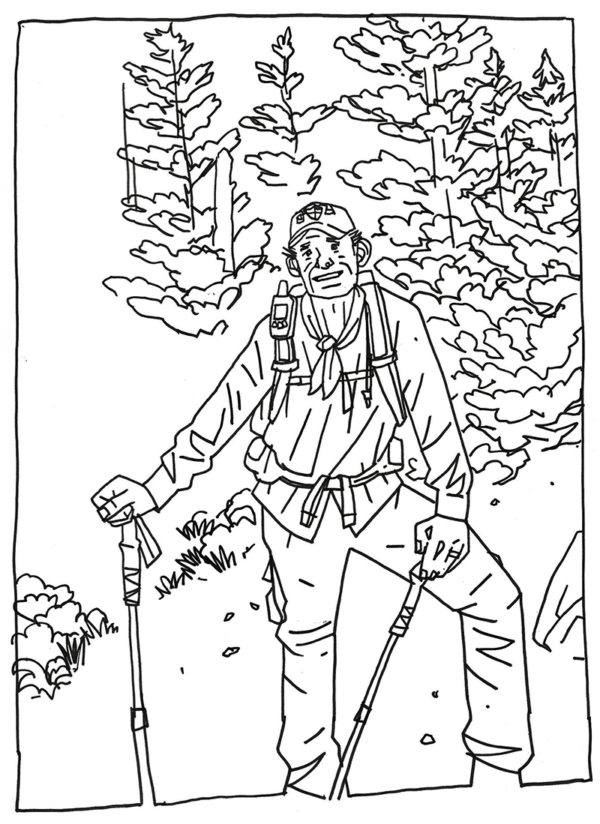
The man was tall, possibly in his early seventies. A sun-faded Army Rangers veteran baseball cap perched atop his head. His lean, sinewy frame conveyed recent time and experience on the trail. As I settled onto the rock beside him, our introductions naturally flowed into shared stories of our hiking journeys. He had that familiar blend of genial grumpiness that I had come to recognize in a few older men I known. He spoke of his retirement project: section-hiking the Pacific Crest Trail. A trail closure ahead due to fire was postponing his plans to complete the PCT this year, but he seemed all right with the delay, acknowledging how the previous days had been challenging. I shared my own stories of past hikes and my recent return to the trail. Then, with a sudden, direct curiosity, he asked, “After all those miles hiked, do you have a trail name?”
I replied that I did not. Without hesitation he strongly stated, “Well, you’re the Birdman!” I was taken aback, asking, “What…?” He simply reiterated, “Yeah! The Birdman. It’s right there…” and he pointed to a sparrow tattoo peeking out from under my shorts just above my left knee. It made me laugh out loud. The morning light was golden and warm, and this kind but unexpected stranger had just given me my trail name. I’m the Birdman!
P.s.
His name was Craig, and he’ seen in the sketch I included with this post